

 ICES
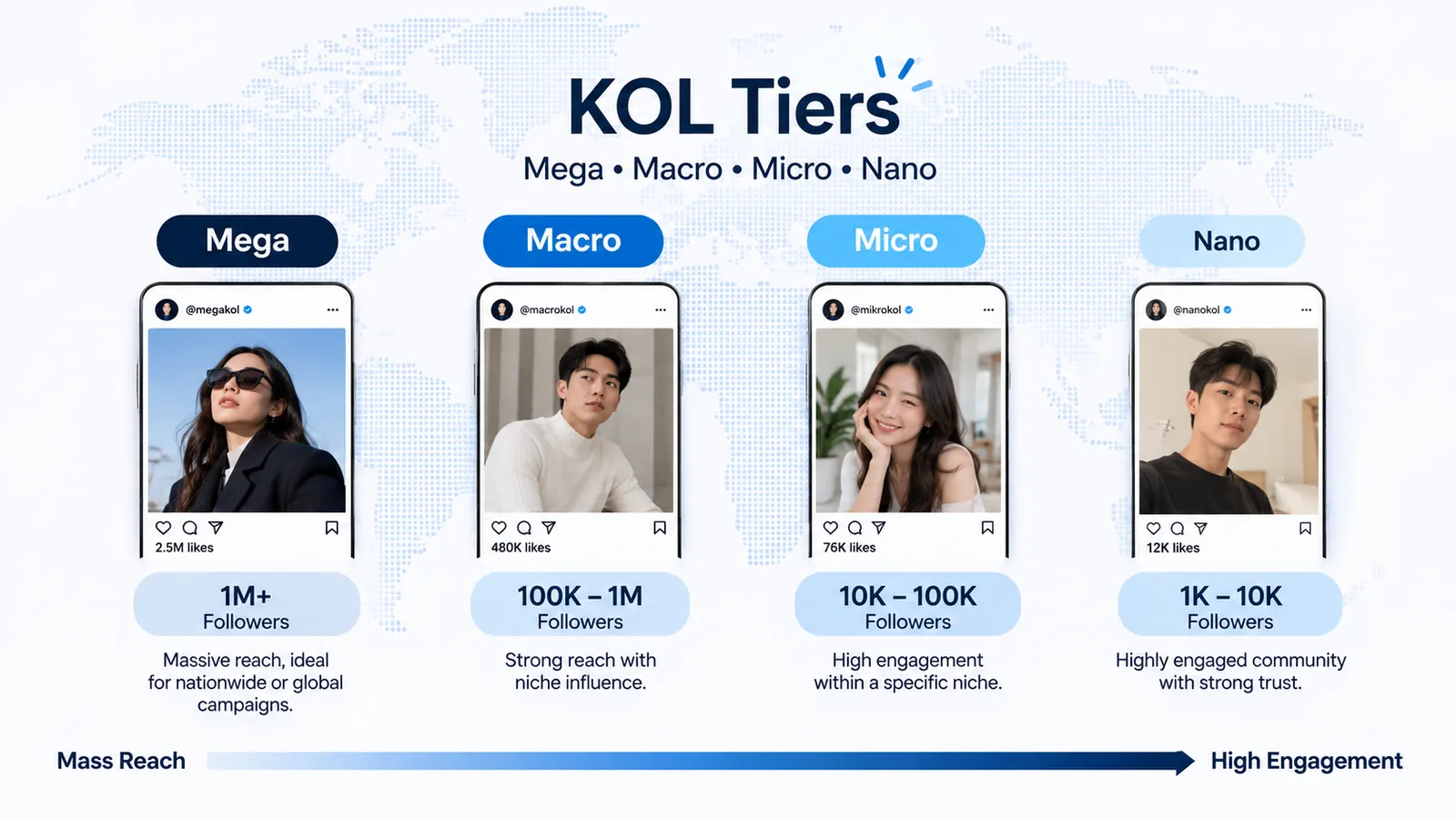
When brands plan influencer marketing, the first question is often "who is the biggest name we can afford?" A better question is "what job do we need creators to do?" This is where KOL tiers help: each tier does a different job.
- Each creator tier does a different job: mega for reach, macro for credibility, micro for conversion, nano for volume.
- Most effective campaigns combine tiers in a pyramid.
- Engagement quality and audience fit matter more than follower count.
Where KOCs fit in
Alongside KOLs, many brands in Indonesia now work with KOCs, or key opinion consumers. These are everyday buyers who post honest reviews and unboxing videos, often as affiliates on TikTok Shop or Shopee. KOCs rarely have large followings, but their content feels close to word of mouth and is often highly persuasive.
An example creator mix
Imagine a skincare brand launching a new serum. A balanced plan might use one well-known beauty creator to announce the launch, eight to ten micro creators to share routines and honest reviews over the following month, and dozens of nano creators and affiliates who post reviews with a TikTok Shop link. Each layer supports the others: the launch creates curiosity, reviews build trust, and affiliates make it easy to buy.
Think in layers, not in single posts.
Splitting budget between tiers
- Awareness-led launches often put more budget into the top of the pyramid.
- Sales-led campaigns usually shift budget towards micro creators, affiliates and paid boosts of their best content.
- Always reserve part of the budget to amplify the posts that perform best.
Common mistakes when choosing creator tiers
- Spending everything on one celebrity: one post creates a moment, but rarely sustained sales.
- Ignoring engagement quality: a creator with fewer but more active followers often outperforms a bigger account.
- Choosing by tier alone: a micro creator outside your category may do less than a nano creator inside it.
- No usage rights: strong creator content becomes far more valuable when you can reuse it in ads.
- No follow-up: one-off posts are forgotten quickly. Repeat partnerships build credibility.
The goal is not to find the perfect creator. It is to build a system of creators that keeps your brand visible, trusted and easy to buy over time.
How ICES can help
ICES plans creator mixes across all four tiers and manages them as one program. Learn more about our KOL and influencer work on the Experience page.
Frequently asked questions
Are micro influencers better than macro influencers?
Neither is better in every case. Micro creators usually have higher engagement and lower cost per post, while macro creators reach more people faster. Many campaigns use both.
What is a nano influencer?
A nano influencer is a creator with a small following, often under 10,000 followers, whose audience is mostly friends and local communities. Their recommendations tend to feel very personal.
How many influencers should a campaign use?
It depends on the goal and budget. Awareness campaigns may use a few large creators, while sales and review campaigns often use dozens or even hundreds of smaller creators and affiliates.
Not sure which creators fit your brand?
We will suggest a creator pyramid for your goal and budget.